TESTED Oxford Instruments Cryo Microstat He MicrostatHe and ITC503 Temperature Controller
Microstat He is a continuous flow cryostat designed to cool samples to cryogenic temperatures for experimental testing using liquid helium or nitrogen. This allows for researching the physical properties of materials, for example, magnetic behavior, optical spectroscopy, and semiconductor testing using optical microscopy.
As you can see in photo #11-12 there is a chip on the inside of the view port window. However, this window still holds a seal with the chamber (we tested it under vacuum) and the chip doesn't go all the way through that viewport plate.
Items Included:
1x ) Oxford Instruments Microstat He
1x ) Oxford Instruments ITC503
1x ) Sensor Cable (HD-15/VGA to female 10-pin connector)
Used, see photos
TESTING
The Microstat's electrical wiring were tested using a resistance meter across the following pins
- Heat exchanger heater to Heat exchanger heater
- Heat exchanger sensor (V+) to Heat exchanger senor (V-)
- Heat exchanger sensor (V+) to Heat exchanger sensor (I+)
- Heat exchanger sensor (V+) to Heat exchanger sensor (I-)
- Heat exchanger sensor (I+) to Heat exchanger sensor (I-)
The Ohm values obtained from testing were within the expected range outlined by the Oxford Instrument user manual (see photo #20)
The Microstat's warming ability and the ITC's temperature control were tested by running the instrument followed by measuring output via IR thermometer, showing heat output and control (see photo #21 and #22).
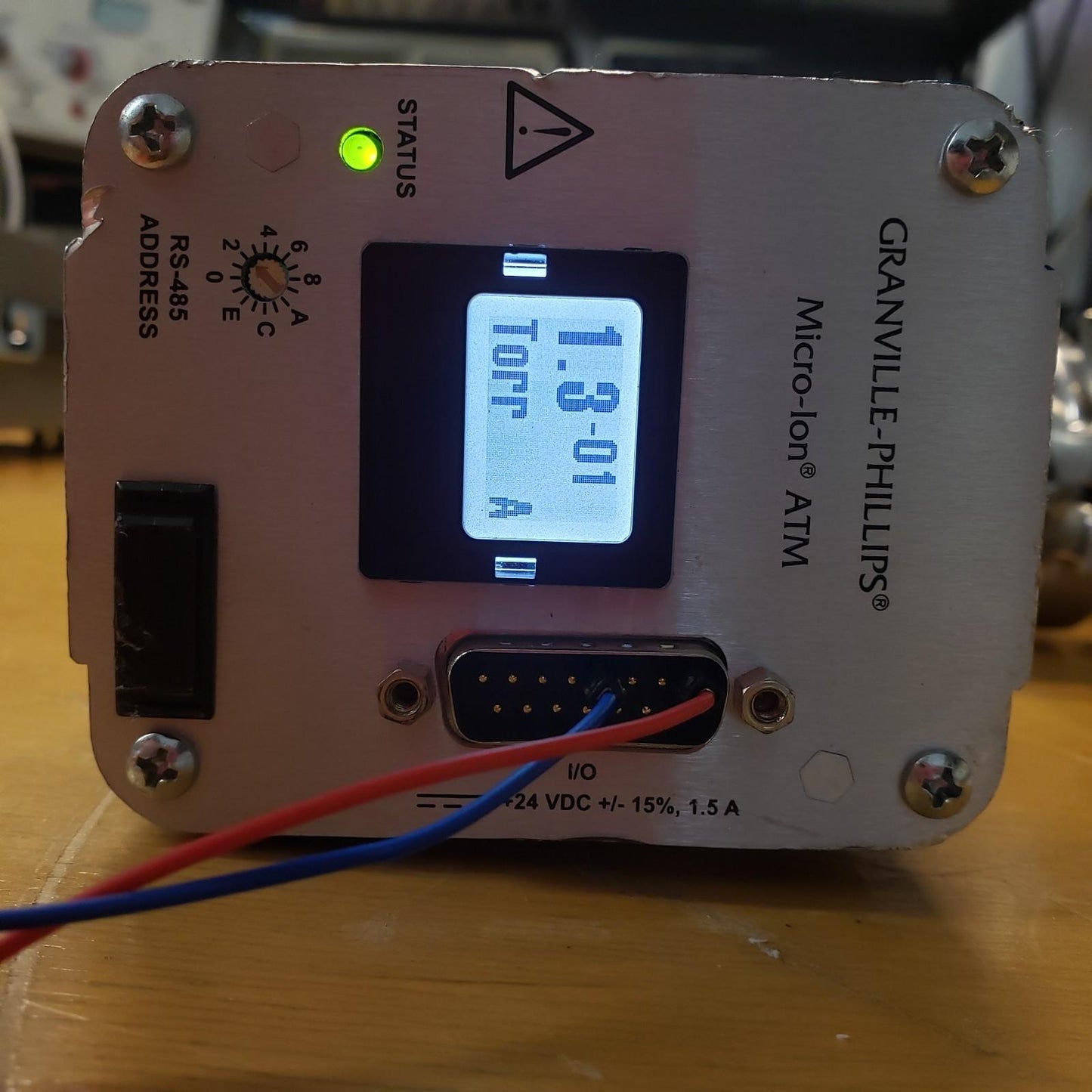
The microstats seal integrity was tested using negative pressure with a vacuum pump and pressure gauge (photo #23 and #24) showing marginal seal and pressure handling. The joint between the microstat body and the vacuum flange is a slightly loose, leading to a small leak but can be re-sealed if needed using sealant appropriate for the use case (we can do this before shipping if you let us know your application).
- BJ